Mostar, home to the Old Bridge – one of Bosnia and Herzegovina’s most famous landmarks – has had a turbulent recent history. While the city has been beautifully restored since the end of the war in 1995, Caroline Sandes discovers that it hasn’t forgotten about the events of the early-to-mid 90s.
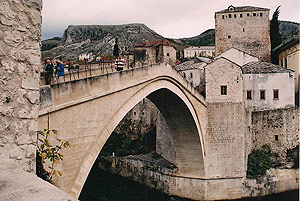 Mostar, synonymous with that beautiful bridge, the Stari Most, was high on my list of places I wanted to visit – but at the same time I wasn’t looking forward to it. The Balkan wars may have come to an end in the mid 90s, but Mostar in 2010 was still very much under repair. Ruins of any period, modern to ancient, fascinate me but the ruins of a comparatively recent war have not yet had the tragedy weathered away.
The bus journey from Sarajevo to Mostar, once the rain had lifted, was lovely. The road twisted and turned through wooded and rocky gorges, the trees in various shades of autumnal colours, before settling into a more gentle route.
Stepping down from the bus in the large modernist bus station in Mostar, I was approached by a guy in his 20s asking if I needed accommodation. In desperate need of a coffee – it was mid-morning and I hadn’t had one yet – I was, inexcusably, a little brusque with him but he kindly pointed me in the direction of the café and waited while I had my espresso. As is common in some places, his family had rooms to let in their house and they were filled by him hanging round the bus station and approaching arriving travellers (it’s a good idea to get them to show you exactly where on a map, and to check the price before agreeing to anything). He lived in east Mostar and, he assured me, close to the centre, so restored by my coffee, we set off in his car. He drove down the street that had formed the front line of the conflict that raged in Mostar causing, most infamously, the purposeful destruction of the Stari Most.
The front line is still very much an avenue of ruin – lined in places by gutted buildings that looked as if a giant rat had gnawed on them, an effect caused by mortar shelling and small arms fire. “How are things in Mostar?” I asked, “Is the city coming back together again?”. His answer was “No. I wish it was, but since the war everything has changed”, tipping his chin up to his right at west Mostar. Had restoring the Stari Most helped (completed with international aid and re-opened with huge fanfare in 2004)? Again, his answer was no. I wasn’t surprised – while the Dayton Agreement that put an end to the Bosnian war was signed in 1995, it takes infinitely longer for a society to heal after such savagery and destruction.
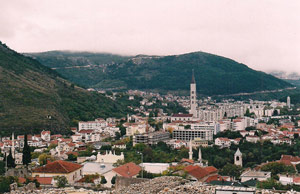
For all of its importance, restoring the Stari Most was not quite the big symbolic re-unifier it was promoted as. Read anything about Mostar and the restoration of the Stari Most and the impression you will get is that it’s a symbolic and physical link between west and east Mostar – but in fact it isn’t. The dividing line was not the river – the bridge is within east Mostar, emphasised by an old and pretty stone mosque that sits on the west bank of the river Neretva, just up from the Stari Most. The dividing line was/is the road that became the front line – a wide multi-lane boulevard running parallel to the river, but west of it. In case you’re in any doubt as to which side is which, just west of this road is an absolutely huge Franciscan church – a modern, concrete replacement for the smaller church destroyed by Serb forces – with a tower of a height so out of proportion with everything else that it is simultaneously absurd and aggressive. It is matched by a huge cross on the summit of the hill above.
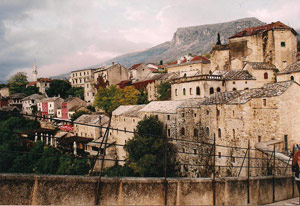 The house I stayed at was a modern, three-storey building. The guy who had driven me from the station introduced me to his father and then dashed off again; there was another room to fill. His father had a kind face and was tall but slightly stooped and as with the lady who ran the place I stayed at in Sarajevo, had an air of sadness. Later on, after I came back from my day’s wandering, he appeared with a plate heaped with deep-fried dough pieces accompanied with some sour cream and cheese, making space for me at the computer table in the passage for me before disappearing back downstairs.
I think it was because I’d booked in for three nights. As far as I could see, people come to Mostar either as part of coach tours from the Croatian coast, ‘do’ the bridge in an hour and flock back to their resorts or (judging by the turn over of the room next to mine) come for a single night, ‘do’ the Bridge and head off again early the next day. Don’t do this if you go to Mostar – both the Stari Most and Mostar itself deserve more than that.
The former is a beautiful and complex piece of engineering and stonework, built between 1557 and 1566 by the Ottomans. It was completely rebuilt between 1999 and 2004 using the original plans (which had survived in an archive in Turkey) and techniques, and quarrying stone from the original quarry, right down to replicating similar stonework flaws for it to fit together. Its reconstruction is a fascinating story in its own right. It’s all detailed, along with the history of the bridge, in the not-to-be-missed Old Bridge Museum in one of its towers on the east bank. Watching them carefully lower the last stone into place in the film in the museum is really quite an emotional moment.
The next morning, having got some still-warm seedy bread rolls from a little bakery for breakfast and stopped for the necessary espresso, I went to visit the small Museum of Herzegovina. It was originally the residence of a former head of the Yugoslavian government, Džemal Bijedić, who died in suspicious circumstances in 1978. There is nothing ostentatious about the building – just a pretty old house in a street. When I got there it was shut, though it was after its opening time, so I hung around for a little while to see if someone would appear to open up.
Sure enough, after about five minutes or so, a grey-bearded man came wandering along, chatting with a companion. Once they’d finished talking, I went over and asked if the museum was open and was duly shown in. He put the film on for me that shows the Stari Most in 1987 and the centuries-old diving tradition – men flying off the bridge and plummeting 24 metres into the narrow, fast-flowing and exceptionally cold aqua marine of the River Neretva (it’s about five metres deep at this point). The film moves on to 1993 at the height of the Bosnian war and includes footage of the moment this dignified and venerable old bridge finally succumbs to the deliberate bombardment by Bosnian-Croat forces, when it crumbled into the river.
The rest of the museum contained some ethnographical material – the goods and chattels of a typical rural/agriculturally-based family (the coffee grinder caught my attention) labelled in English, but the room given over to Džemal Bijedić, who I was more curious about, had nothing in English.
After the museum, I continued up the hill to a tiny Orthodox church. How it survived – most of the Orthodox churches, thanks to their association with Serbia, were destroyed during the Bosnian war – I’m not sure, but the large several-storeyed ruined building directly in front may explain it. There was someone in the church when I got there and unwilling to disturb I stayed outside. He soon came out and on seeing me, ushered me in for a closer look. Behind the church was a huge graveyard that spread out across the gully. Mostar, like Sarajevo, is dotted with graveyards: Muslim, Christian, Jewish; headstones uniform in their contemporaneity. The Bosnian war between 1992 and 1995 accounted for between 100,000 and 110,000 deaths, making it the most devastating conflict in Europe since 1945.
From there I wandered back down and along Maršala Tita on to Braće Fejića, the main street running parallel to the river on the east bank. There were still quite a few old ruined buildings – signs warning not to enter and facades propped up with scaffolding, the weeds and saplings making inroads into the stone work. I took a couple of photographs, receiving a smile from a passer-by but then a glare from another. Although I can justify taking photos of war damage as being for research, I can understand why some people are uncomfortable with it.
I took a turn down a little alley to go and visit the Bišćevića Ćošak – a 350-year-old Turkish house. Part of it is propped up on amazingly tall stilts above the river, and it is beautiful – all dark wood and carpets – but I had the misfortune to arrive just behind an Italian tour group. Given that the house isn’t very large, I waited while they were given their tour before taking a look myself. There was a lemon tree in the courtyard that seemed a little incongruous in its summeriness against the grey sky.
 Leaving there, the rain came down and looked set for the afternoon, so I made my way over to a café by the Stari Most, ordered a ‘piva’ (beer) and settled down with The Bridge over the Drina, Ivo Andrić’s classic novel that spans four centuries, the main character of which being the bridge. It is both a good introduction to the history of the Balkans, Bosnia i Herzegovina in particular, and how a bridge such as the Stari Most develops such significance (the book is based on a real bridge over the Drina in Višegrad, now a World Heritage Site).
The rain did clear though, so I walked over to West Mostar. It has a different feel to it – wider streets, more upmarket shops, more grand houses – some ruined, some surviving, some being restored (I also stuck my head into the huge Franciscan church but it seems all their energies went into building its tower).
What I really wanted to take a look at was the Partisans Memorial Cemetery – it’s not in the guide book but was marked on the touristy map of Mostar that I’d picked up, and I was intrigued. Overgrown and apparently, judging by the broken beer bottles, serving as somewhere to drink, among other things, I got in by venturing down a grass path leading off the road that seemed to be going in the right direction. There is a large and complex modernist-style monument/landscape that comprises a series of levels, each with numerous and identical horizontally placed headstones carved with a name and dates.
The monument surrounds the burial area on three sides and looks out over Mostar. I noticed that there had been some repairs done – they were still white compared to the weathered and blackened state of the rest of it, which seemed odd considering the general neglect of the place. Looking it up later I discovered it was built to commemorate the Communist Yugoslav Partisans of Mostar killed during the Second World War and that it was designed by Bogdan Bogdanović, architect and former mayor of Belgrade who, incidentally, was so horrified at the deliberate urban destruction that was such a feature of the 90s Balkan wars that he defined it as ‘urbicide’.
The cemetery was opened in 1965 by Marshal Tito himself. It contains the remains of 560 combatants, and a mausoleum with remains from mass graves, all gathered up for burial here. As with everything else in Mostar it was badly damaged by bombing during the war but restored in 2004 and designated a National Monument by the Bosnia and Herzegovina Commission to Preserve Monuments. Sadly, it seems not to have been subsequently been maintained.
Next day, it was time to move on; I said goodbye to the kind person running the place I had been staying in, reluctantly turning down his offer of coffee – I needed to catch the bus to Dubrovnik. Dubrovnik was to be easy after Sarajevo and Mostar – all red roofs, sunshine and little evidence of conflict – except for that lost puppy…
For my month-long Balkan trip, I used the Lonely Planet Western Balkans guide book, the Lonely Planet Eastern European phrase book, and the Freytag & Berndt Balkans/South-East Europe map.
- Browse our collection of maps, guides and travel literature for
- > Bosnia and Herzegovina.