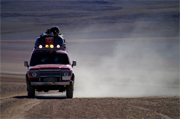
 There is a certain appeal in entering a country by the backdoor. Especially if that backdoor is a wide open vast desert with nearly 6,000m-high peaks. The Bolivian border post, was just that, a post with a sign showing only two words on opposing sides – “Bolivia”, where we were going, and if you turned round you could see “Chile”. The passport stamp came only four days later in the first proper town.
The four days unaccounted for in my passport were spent in a jeep with two Bolivians and three fellow foreign travellers in one of the driest and highest deserts on Earth. Harsh nature at its best. The guide/driver did a great impression of one my favourite scenes from the classic film “The English Patient” where a desert tour is described – endless desert stretches are negotiated without a word spoken before coming to an abrupt stop and the driver pointing out some remote feature and exclaiming with pride “Laguna Verde” (green lake) or “Arboles de Piedra” (trees of rock) – the actual line has Ralph Fiennes’ character, Count Laszlo de Almásy, say, “I once travelled with a guide, who was taking me to Faya. He didn’t speak for nine hours. At the end of it he pointed at the horizon and said, ‘Faya!’ That was a good day”. Otherwise the desert speaks for itself. The drive goes to well over 4,000m altitude, necessitating the traditional remedy for altitude sickness – coca-leaf tea. Some locals like to point out that, supposedly, even Pope John Paul II has tried it on his visit to the Andes highlands.
From here it is on to another high point – the world’s highest city in fact – called Potosi. The other attraction of Potosi, apart from superb Spanish colonial architecture, is to sink into the depths of the family-run hand-worked silver mines. You slide down rather narrow tunnels for a chat with the coca-leaf chewing miners – after all, even in the deepest tunnels you are pretty high up – some of whom are frighteningly young, like our assistant guide. One can only hope that enough of this tourism income does filter through to where it is really needed.
The world’s highest capital is La Paz (rival city Sucre is also worth visiting for its old Spanish flair and it remains the judicial capital). La Paz should not be missed while you are up here – that’s unlikely anyway as it’s a major transport hub. It is the only city that I have ever been to where the poorest part of the population has the best view – from the Altiplano plateau into a spectacular city centre valley – while the rich live right at the bottom, where you don’t lose your breath within seconds. La Paz has endless markets brimming with fruit and vegetables, livestock and souvenirs (some are brand-new, others antique and some just antique-looking). The famous witches’ market has everything you could possibly never need – from colourful herb offerings to llama foetuses.
From La Paz it is not far to the beach of Copacabana. No, the altitude is not finally getting to me. There is indeed a town sharing a name with Rio’s main beach on the shores of, you guessed it, the world’s highest lake, Titicaca, where many of the fishermen still ply their trade in traditional reed boats. Isla del Sol in the lake is one of those places people come to for a day but end up staying several more – just relax in ancient Inca surroundings and watch the sun go down.
Still having not had enough of those heights, I decided to climb an Andes 6,000-metre-er – all right, I admit, since you start so high up, this is not the world’s highest climb, but it certainly felt like it. I had met this French mountain guide who would take me up on the cheap. So cheap in fact that the crampons did not fit the boots properly on day one, and at 5,500m on the morning of day two not at all. Needless to say we did not reach the top. I console myself with the rumour that this peak is incorrectly surveyed and in fact a few metres short of that mythical 6,000 anyway. Well, that leaves me with an unfulfilled ambition, next time to be attempted with top-class equipment only!
Enough of heights, time for some lowland. The lesser-known part of Bolivia is the north-east with vast rivers eventually flowing into the Amazon, brimming with river dolphins, caimans and anacondas. Rurrenabaque has such a nice ring to it, I just had to visit. This also happens to be the perfect base for touring the jungle and pampas (lowlands). We sat many hours of the evening with torches ready to spot a tapir or jaguar, but they would not show themselves. Yet the next morning tapir prints awaited us in the river sand – another reason to come back and try again.
The best way of exploring Bolivia is with the Footprint Bolivia Handbook suitable for all budgets with great background information – or the Bolivia Lonely Planet – especially if you are looking for spots where backpackers congregate, their town maps are always pretty good in one hand, with the Nelles Bolivia/Paraguay map in the other. And I will also recommend Bradt’s Peru & Bolivia: Backpacking & Trekking (now out of print) that guided me securely on numerous other walks and the 1:50000 Alpenverein maps Cordillera Real North: Illampu and Cordillera Real South: Illimani.
Browse our collection of Bolivia Maps and Guide books here >
Author: Gerhard Buttner